The Art of Keeping an Inspiration Journal: Free Your Creative Mind
Discover the nuances of keeping an inspiration journal to capture ideas that get lost in the flow of daily life and to guide your artistic output.
Our minds come into contact with thousands of visuals, sounds, emotions, and ideas throughout the day. However, a large portion of these inputs is forgotten before we find the time to pause and reflect on them. Achieving continuous freshness in artistic production is possible by capturing those initial sparks that strike the mind. An inspiration journal, also known as a visual notebook or art journal, is not merely a space where finished works are displayed; on the contrary, it is a personal laboratory where mistakes, experiments, and raw ideas freely flourish.
Keeping an inspiration journal to overcome blocks encountered in creative processes and to organize mental capital is one of the strongest bridges an artist can build with their inner world.
What Is an Inspiration Journal and Why Keep One?
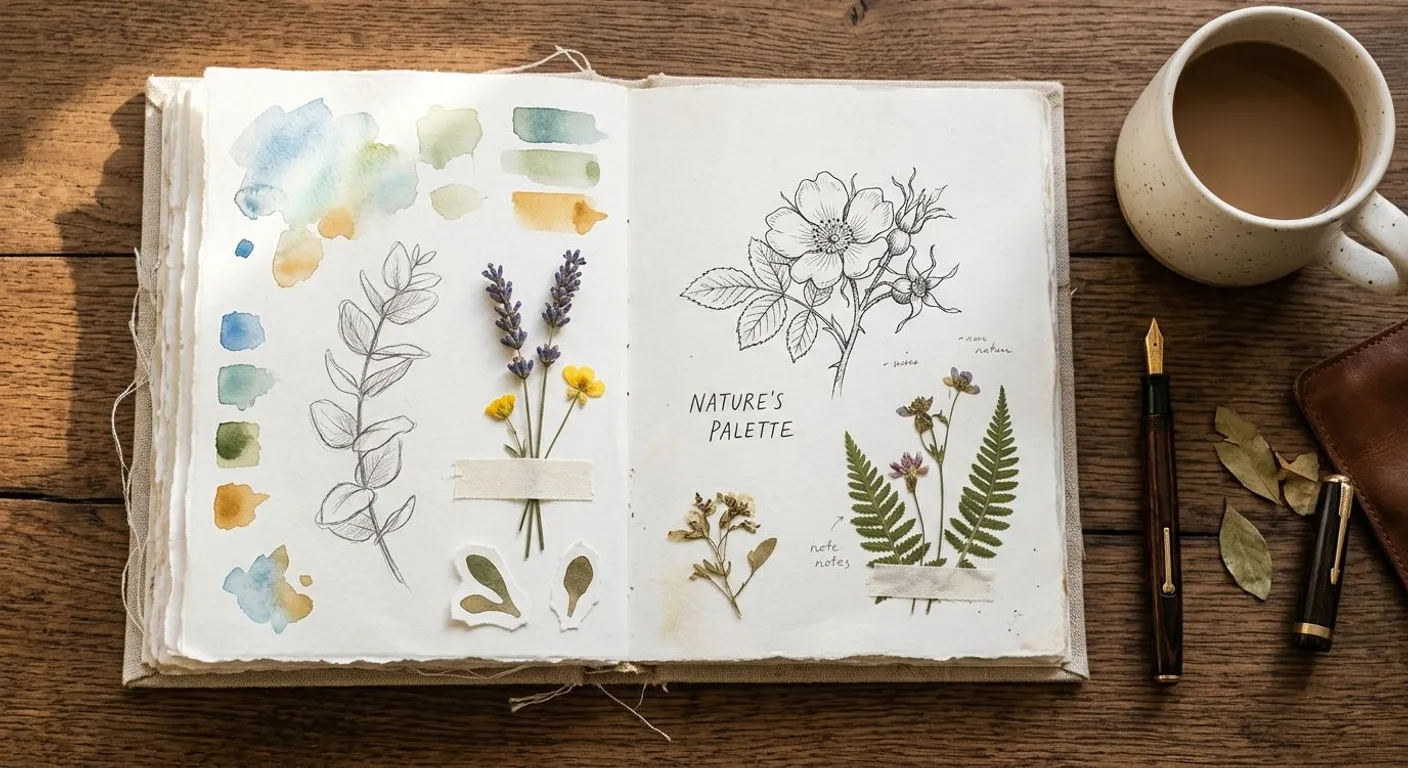
While traditional diaries predominantly rely on words, an inspiration journal has a multisensory structure. Ticket stubs, fabric scraps, dried leaves collected from nature, a quickly drawn contour, or a note of a sentence overheard on the street can form the main material of this notebook.
The primary purpose of keeping an inspiration journal is not to create a perfect visual display. On the contrary, it is to lift the pressure of perfectionism off your shoulders. When you want to resolve stalls in the creative process or open doors to new ideas, one of the most effective methods among ways to overcome creative block is to free the mind and transfer thoughts into this notebook without rules.
This practice offers you the following advantages:
- Strengthens Visual Memory: Recording the color combinations and textures you encounter creates a rich reference library for your future projects.
- Provides Mental Clarity: Pouring complex ideas swirling in your mind onto paper makes it easier to focus.
- Accelerates Style Development: It enables you to discover your personal signature by noticing themes, colors, and forms you frequently return to unconsciously.
Digital and Physical Journals: Which Method Suits You Best?
When creating an inspiration journal, you can choose the traditional pen-and-paper duo, or take advantage of digital tools thanks to evolving technology. Both approaches offer unique contributions to artistic production.
Working with a physical notebook involves feeling the texture of the paper, the scent of the paint, and the tactile experience brought by collage and pasting. On the other hand, digital journals provide great convenience in terms of unlimited layer usage and portability. When making your application choices, you can consider your criteria regarding choosing a digital drawing tablet.
| Feature | Analog (Physical) Inspiration Journal | Digital Inspiration Journal |
|---|---|---|
| Tactile Experience | High (Paint, collage, paper texture) | Low (Screen surface) |
| Error Correction | Limited (No undo button) | Unlimited (Layers and easy erasing) |
| Portability | Depends on notebook size and materials | Very high (Tablet or phone) |
| Privacy and Backup | Requires physical protection | Secure with cloud backup |
4 Essential Techniques to Feed Your Inspiration Journal
There are practical techniques you can apply to overcome the fear of the blank page and start filling the pages.
1. Collage and Ephemera Collection
Collect objects you encounter in daily life that evoke an emotion in you. An exhibition brochure, wrapping paper, or a coffee stain... Glue them randomly onto the page and add drawings over them. Collage quickly breaks down the mental barrier that comes with drawing from scratch.
2. Color Palette and Texture Studies
Select three colors that catch your attention during the day and make small swatches with these colors in your notebook. Thinking about the secret power of colors while observing how colors harmonize with one another contributes to creating emotional atmospheres.
3. Automatic Writing and Free Drawing
Write down whatever comes to mind without grammar or aesthetic concerns. Then insert lines drawn spontaneously by your hand between these words. This exercise helps suppressed subconscious ideas surface.
4. Field Studies and Creating a Focus Space
Use your journal actively not just at home, but outside as well. While sitting in a park, a café, or a museum, quickly jot down small details around you (a person's posture, the angle of light coming through a window). If you would like to make such experiments in your own living space, you can design a minimalist space like in setting up an abstract painting studio at home.
How to Build a Sustainable Inspiration Routine
The most critical aspect of keeping an inspiration journal is consistency. You don't need to spend hours every day; spending even 10 minutes a day will keep your mental muscles flexible.
- Don't Tie It to a Specific Time of Day: Open the notebook not only when inspiration strikes, but also when you feel blocked.
- Do Not Try to Perfect the Pages: An inspiration journal is for discovery, not for display. Pages that look messy or unrefined are the most natural part of the process.
- Always Carry Your Notebook with You: A small notebook and a single pen prevent you from missing fleeting ideas.
References
References
Frequently Asked Questions
Is drawing ability required to keep an inspiration journal?
No, drawing ability is not required. An inspiration journal can easily be created using collages, photos, text clippings, color swatches, and personal notes.
What kind of notebook should be chosen for an inspiration journal?
If you plan to use wet techniques like watercolor or collage, notebooks with paper weighing at least 200 gsm should be preferred. For just drawing and note-taking, dotted or plain sketchbooks are sufficient.
What is the difference between an inspiration journal and a classic diary?
While a classic diary chronologically records events and emotions through writing, an inspiration journal aims to archive creative ideas by combining visual, tactile, and textual materials.
This content was researched and prepared by the İlgi Alanları editorial team and reviewed for accuracy and readability before publication. Information on health, finance and investment topics is general in nature and does not replace professional advice.