Understanding Dark Matter: In Pursuit of the Universe's Mysterious 85%
There's a substance that makes up a large portion of the universe but cannot be seen: dark matter. Discover what this mysterious component is, the scientific evidence for its existence, and how scientists are attempting to solve this cosmic enigma.
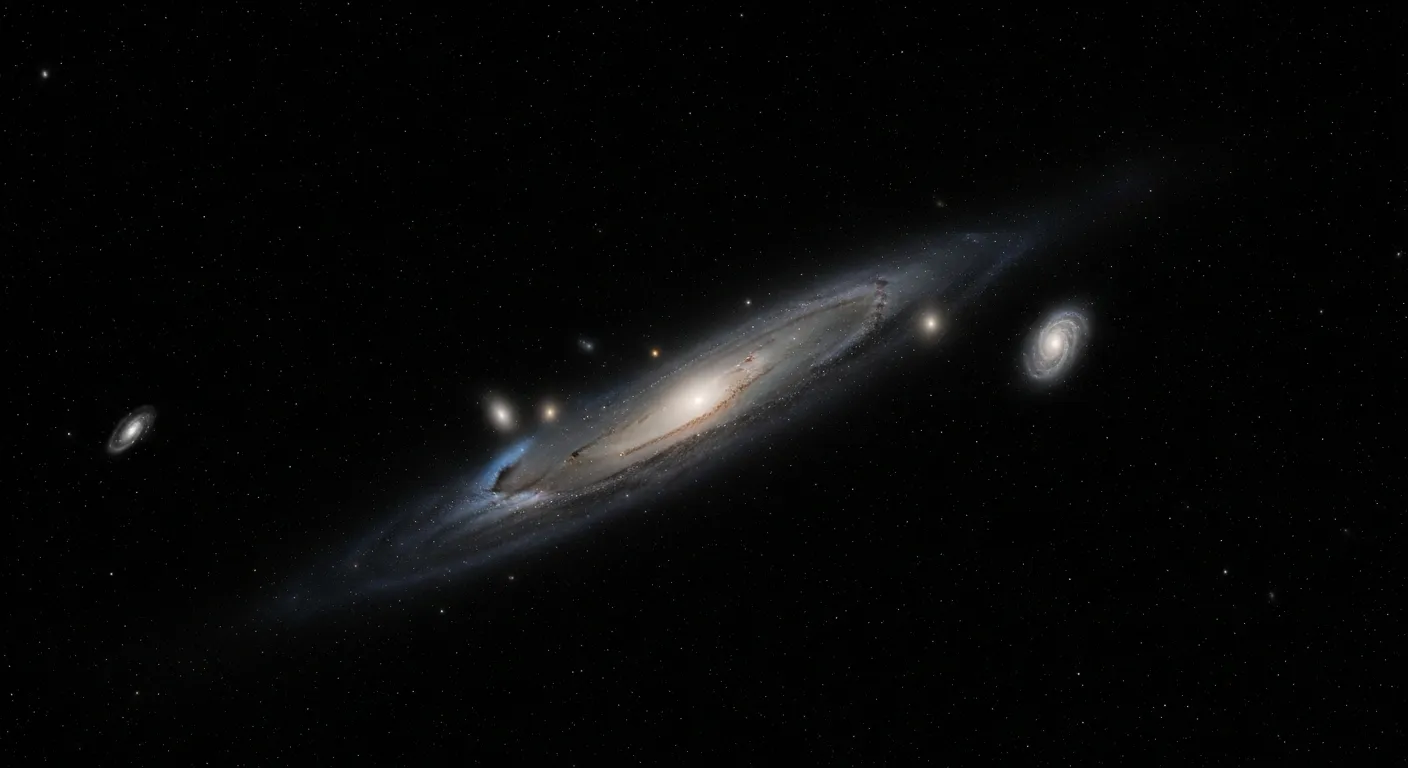
The universe holds far more than everything we know. The stars, galaxies, planets, and even ourselves that we see constitute only a small fraction of the universe's total mass and energy. The vast remainder is still shrouded in mystery. One of the largest pieces of this mystery is dark matter. This enigmatic substance, which we cannot directly observe and which does not interact with light, continues to be one of the cosmos's greatest puzzles. This article delves into what dark matter is, the scientific evidence for its existence, and how scientists are attempting to understand this invisible component.
What is Dark Matter? The Universe's Invisible Architect
Dark matter, as its name suggests, is a type of matter that does not emit, absorb, or reflect light. It cannot be detected at any wavelength of the electromagnetic spectrum. This is the fundamental characteristic that distinguishes it from normal matter, i.e., baryonic matter like protons, neutrons, and electrons. Baryonic matter encompasses everything that forms stars, planets, and living beings, interacts with light, and can therefore be observed with our telescopes.
Approximately 68% of the universe's total mass-energy density consists of dark energy, 27% dark matter, and only 5% known normal matter. This distribution is one of the cornerstones of the standard cosmological model. Dark matter gets its name
Frequently Asked Questions
Does dark matter really exist?
Yes, although it cannot be directly observed, strong observational evidence such as galaxy rotation curves, gravitational lensing, and cosmic microwave background radiation supports the existence of dark matter.
Why is dark matter invisible?
Dark matter does not interact with light or other electromagnetic radiation; meaning it does not emit, absorb, or reflect light. Therefore, it cannot be directly detected by our telescopes.
What is dark matter made of?
The composition of dark matter is not yet known. The most popular candidates include hypothetical exotic particles such as WIMPs (Weakly Interacting Massive Particles) and axions.
Why is dark matter difficult to detect?
Dark matter is difficult to detect because it interacts only through the gravitational force. It interacts very weakly or not at all with the other fundamental forces (electromagnetic, strong nuclear, weak nuclear).
Does dark matter pass through the human body?
If dark matter particles consist of weakly interacting particles, particularly WIMPs, then billions of dark matter particles could be passing through our bodies every second unnoticed.
This content was researched and prepared by the İlgi Alanları editorial team and reviewed for accuracy and readability before publication. Information on health, finance and investment topics is general in nature and does not replace professional advice.