Wireless Power Transfer: Understanding the Charging Revolution in Homes
Ready to break free from cable clutter? Wireless power transfer is opening the doors to a revolution that will fundamentally change how we charge devices in our homes. This article will delve deep into this technology.
The increasing number of electronic devices in our homes daily brings with it a tangle of cables. Phones, tablets, smartwatches, headphones, and other smart home appliances... The search for different adapters and outlets to charge each of them has become an inevitable part of modern life. However, wireless power transfer (WPT) technology has the potential to put an end to this cable clutter. In the future, the way we charge devices in our homes could fundamentally change.
In this article, we will delve into what wireless power transfer is, how it works, its current technologies, and how it can create a charging revolution in homes. We will also examine the advantages, challenges, and future potential of this technology.
What is Wireless Power Transfer and How Does It Work?
Wireless power transfer is based on the principle of transmitting electrical energy from a transmitter to a receiver without physical contact or a conductive cable. Although this concept was first introduced by Nikola Tesla in the late 19th century, its current applications are much more advanced.
Fundamentally, wireless power transfer uses electromagnetic fields. The transmitter converts electricity into an energy field, which is then captured by a coil or antenna in the receiving device and converted back into electrical energy. This process varies depending on the distance and the technology used.
Fundamental Methods Determining the Operating Principle
Wireless energy transfer can occur based on different physical principles:
- Inductive Coupling (Inductive Charging): This is the most commonly used method. When two coils (transmitter and receiver) are placed very close to each other, an alternating current passing through the transmitter coil creates a magnetic field. This magnetic field induces a current in the receiver coil, thereby transferring energy. Smartphone charging pads operate on this principle. Close contact is essential for energy transfer.
- Magnetic Resonance Coupling (Resonance Charging): This method also uses magnetic fields but, unlike inductive charging, the transmitter and receiver coils are tuned to the same resonant frequency. This allows for more efficient energy transfer over longer distances and even through some obstacles (like tables, books, etc.). You can think of it like two instruments resonating at the same frequency causing each other to vibrate.
- Radio Frequency (RF) Power Transfer: This method uses electromagnetic waves (radio waves) to carry energy. The transmitter emits radio waves, and an antenna in the receiving device collects these waves and converts them into electricity. It offers the potential for energy transfer over longer distances, but current efficiency levels and safety concerns limit its widespread use. This technology holds promise especially for low-power sensors or small IoT devices.
- Laser or Infrared Light Transfer: Energy transfer using laser beams or infrared light is also theoretically possible. While it has high efficiency potential, it has not yet become widespread due to safety concerns (such as eye contact) and the requirement for a direct line of sight.
The Wireless Charging Revolution in Homes: Potential Applications
The integration of wireless power transfer into homes has the potential to fundamentally change our daily habits. We may no longer have to search for outlets or deal with cables to charge our devices.
Smartphones and Wearable Devices
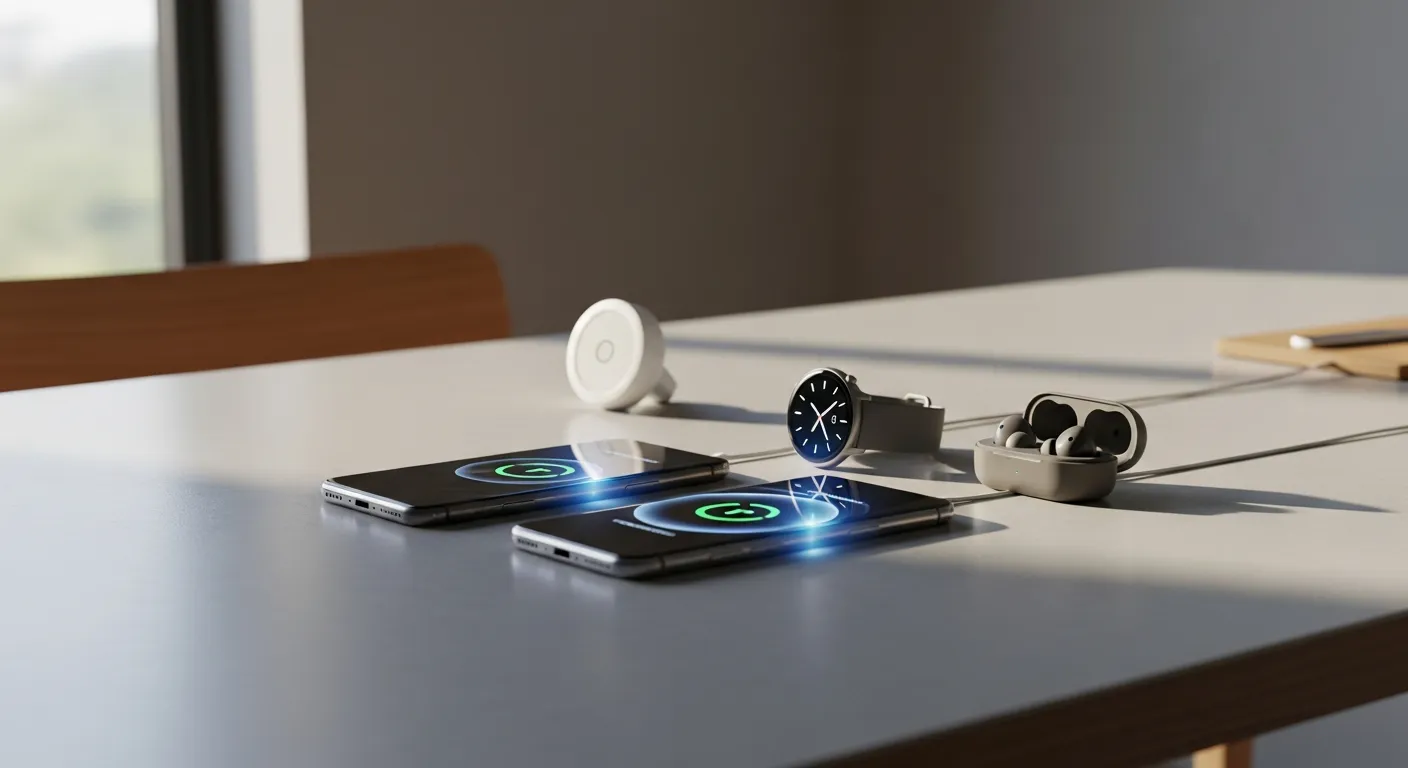
Personal devices such as smartphones, smartwatches, and wireless headphones have been the first and most common application areas for wireless charging. Thanks to inductive charging protocols like the Qi standard, compatible devices can be easily charged by simply placing them on charging pads. In the future, with charging areas integrated into our tables, nightstands, or even sofas, our devices will be able to charge automatically wherever we place them.
This will greatly increase ease of use, especially for wearable technologies that require continuous power, such as Augmented Reality with Smart Glasses: The Future Before Your Eyes.
Smart Home Devices and Sensors
Smart home ecosystems are one of the areas that will benefit most from wireless power transfer. Devices such as wireless cameras, smart sensors, thermostats, or Smart Door Locks and Home Security Technologies: A Comprehensive Guide will be able to operate without constant battery changes or cable connections. Thanks to transmitters integrated into walls or placed at strategic points within a room, all small devices in the home can be continuously charged. This way, devices like Automatic Watering Systems for Houseplants: Easy Care, Healthy Plants can also operate uninterruptedly.
Long-Range Wireless Power Rooms
Some companies are developing technologies aimed at transforming an entire room into a wireless charging zone. For example, systems like WattUp or Wi-Charge can charge devices at a certain distance using low-power radio frequencies. This means you can charge your devices anywhere in the room, just like a Wi-Fi signal. These technologies hold great potential, especially for IoT devices, wireless sensors, and smart home automation.
Advantages and Challenges of Wireless Power Transfer
Like any new technology, wireless power transfer has its unique advantages and challenges that need to be overcome.
Advantages
- Ease of Use: Eliminates the hassle of plugging and unplugging cables. Simply placing the device on the charging area is sufficient.
- Aesthetics and Organization: Reduces cable clutter, providing a more organized and aesthetic appearance in homes and offices.
- Durability: Reduces physical wear and tear on charging ports, potentially extending device lifespan.
- Safety: Reduces some risks associated with water and electrical contact.
- Automation Potential: Enables continuous operation by providing constant power, especially in smart home systems and IoT devices.
Challenges
- Efficiency: Energy loss can occur, especially over long distances. It may have lower energy efficiency compared to wired charging.
- Distance Limitation: Most current technologies (especially inductive) require close proximity between the transmitter and receiver.
- Cost: Wireless charging devices and integrated systems can be more expensive than traditional wired solutions.
- Standardization: Different manufacturers using different standards can lead to compatibility issues.
- Safety and Health Concerns: Research continues on the potential effects of electromagnetic fields on human health and their interaction with devices, especially for far-field and high-power transfer technologies.
Wired Charging vs. Wireless Charging Comparison
| Feature | Wired Charging | Wireless Charging (General) |
|---|---|---|
| Efficiency | High (very little energy loss) | Low to moderate (decreases with distance) |
| Ease of Use | Requires plugging/unplugging cables | Simply place device, contactless |
| Distance | Only cable length | Short range (inductive) or medium/long range (resonance/RF) |
| Cost | Generally lower | Generally higher |
| Aesthetics | Can create cable clutter | More organized and aesthetic |
| Safety | Risk of electric shock from physical contact | Electromagnetic field exposure concerns |
| Universal Compatibility | Broad compatibility with most USB standards | Not yet fully universal, different standards |
Safety and Health Considerations
When it comes to wireless power transfer, concerns about exposure to electromagnetic fields (EMF) can arise. Organizations like the World Health Organization (WHO) continuously research the effects of low-frequency EMFs encountered in daily life on human health. Current inductive charging pads are generally considered to pose no significant risk as they use very low-power magnetic fields and require close contact with the device. However, establishing safety standards and guidelines for future, more powerful, and longer-range systems is critically important.
Manufacturers design and test devices in accordance with safety standards. It is also important for users to choose certified and reliable products. Safety should always be a priority for smart home systems and other technological advancements in homes.
Future Perspective: The Evolution of Wireless Charging
Although wireless power transfer technology is still in its early stages, it has the potential to fundamentally transform our living spaces in the future. Thanks to transmitters integrated into walls, it's not a dream for our devices to start charging automatically when we enter a room. Charging modules embedded in kitchen countertops or desks will allow us to charge our devices even while we are using them.
Scenarios such as wireless charging of electric vehicles at home, battery-free operation of wireless sensors, and even wireless power for household appliances illustrate the potential reach of this technology. With standardization, increased efficiency, and reduced costs, wireless power transfer is poised to become one of the most significant innovations to relegate the cable clutter of the digital age to history.
Wireless power transfer is not just a technological advancement; it is also a promise to create more organized, more efficient, and more aesthetic living spaces. This revolution is entering our homes step by step, laying the foundation for future technological integration.
Frequently Asked Questions
Is wireless power transfer safe?
Low-power inductive systems, such as current wireless charging pads, do not pose a significant risk to human health. Safety standards and research are ongoing for more powerful and longer-range systems.
Why is wireless charging slower than wired charging?
Wireless charging experiences some energy loss during power transfer. This loss can lead to lower efficiency and thus slower charging times compared to wired charging, but this difference is decreasing as technologies evolve.
Which devices support wireless charging?
Today, many smartphones, smartwatches, wireless headphones, and some tablets support popular wireless charging standards like the Qi standard. Compatible devices can be charged on charging pads.
Do I need a special device for wireless charging?
Yes, you need a device that supports wireless charging (e.g., a Qi-compatible phone) and a wireless charging transmitter (e.g., a charging pad or stand) that can charge it.
Does wireless power transfer work over long distances?
While inductive charging requires close proximity, resonance and radio frequency (RF)-based technologies have the potential for energy transfer over longer distances. However, these technologies are not yet widespread, and their efficiency varies with distance.
This content was researched and prepared by the İlgi Alanları editorial team and reviewed for accuracy and readability before publication. Information on health, finance and investment topics is general in nature and does not replace professional advice.